Showing posts with label concept. Show all posts

Sunday, February 12, 2012

DwellStudio Board Books

DwellStudio (2009), 8 pages

Audience: babies, toddlers

Format: board book

Stylish, modern, and educational … designer DwellStudio has created great starter books for babies and toddlers. Simplified, minimal, outlined objects and animals such as a bear, house, whale, etc. (inspired by their design product line) are perfect subject matter for infants and young children. The glossy black and white images are not only appealing to young audiences; they are especially effective for babies whose vision is still developing in the first few months. However, the black and white images are sparingly paired with bright pops of color to add interest and whimsy; for instance the whale depicted in black and white pops with a turquoise splash of water. Published as board books, this series is both sturdy and durable-perfect for babies and toddlers. Although on the small size (7x7) they are just the right size for lap reading. However, since the images are bright and graphic they may translate well for baby storytime … if concerned about size enlarge the pictures, create felt board cutouts, and display them for everyone to see. Introducing babies to books is important; while being read to, they make connections to words and sounds making reading out loud not only a sensory experience, but also instrumental to early literacy.

In addition, the Dwell Studio has developed baby books devoted to learning colors, textures, and more. For instance, What Colors? was produced as an accordion-style (see bottom image) book which folds out to illustrate a rainbow of color. This unusual format would be great for baby storytimes since the “pages” are unfolded to reveal a large, colorful panel. Have parents create their own accordion-style book with folded construction paper and stamp or outline images. Dwell Studio’s most tactile books for children are their Touch & Feel series; using different textures and patterns not only help engage children – they are a great sensory experience, another way to make reading fun!

Reviewed by: Katharine Conn, MLIS

If you liked this book, you may like: White on Black by Tana Hoban or Charley Harper’s 123s or ABC Books, Sara Anderson’s Vegetables or Fruit

Other books by this company: Eat, Go, Count, Touch & Feel Zoo, Touch & Feel Town, Goodnight Owl, and Good Morning Toucan

Sunday, April 17, 2011

Counting with Wayne Thiebaud

Susan Goldman Rubin (2007), 26 pages

Audience: babies, toddlers

Format: board book

Foster art appreciation at an early age whilst teaching your baby or toddler how to count. The artwork of contemporary artist, Wayne Thiebaud (famous for delicious renditions of candies, pastries, and cakes) makes counting a delight! Rubin reproduces a sampling of Thiebaud’s works, including Pie Slice (1991), Jolly Cones (2002), Sugar Sticks (1964) and many more to create a decadent counting book from 1-10. With minimal text and a carefully crafted sequence, “One piece of pie, two ice-cream clowns, three sandwich slices, three pickle rounds,” … Rubin creates a clever and simple counting book featuring Thiebaud’s beautiful artwork. With each turn of the page, readers are treated to Thiebaud’s painterly pastels, oils, and watercolors – each one striking and luscious; a sweet treat for readers everywhere! In addition, the book includes a complete catalog of the works used along with collection locations. Published in a board book format with rounded edges and in a compact size makes this ideal for little hands. Rubin has used other artists such as Warhol and Matisse as inspiration for children’s books. Her books are a great introduction to modern art and before long you’ll be visiting some museums to these works in person!

Reviewed by: Katharine Quinn, SJSU MLIS Student

If you liked this book, you may like: Touch the Art: Make Van Gogh’s Bed by Julie Appel or My First ABC by The New York Metropolitan Museum of Art, or A is for Art: An Abstract Alphabet by Stephen T. Johnson

Other books by this author: Delicious: Wham! The Art and Life of Roy Lichtenstein, Matisse Dance with Joy, and Andy Warhol’s Colors

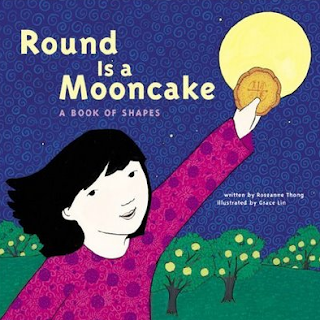
Round is a Mooncake: A Book of Shapes

Roseanne Thong (2000), 34 pages

Illustrated by Grace Lin

Audience: toddlers

Format: picture book

In Thong’s book, Round is a Mooncake, everyday objects, food, and environment construct lessons in shapes and Chinese-American culture. A premise, which creates an interesting and rich backdrop of circle, square, and rectangle shapes as described by one little girl discovering them among her surroundings. The author’s use of simple language, repetition, and rhyming text is engaging and descriptive. For instance, “round is a mooncake, round is the moon; round are the lanterns outside my room.” Thong uses equal parts Chinese and American references to discuss common shapes. For example “square is the box that pizza comes in; and dim sum made by Mrs. Chin” an illustration shows the family eating a meal of pizza slices and Chinese dim sum. In addition, prompting techniques are used throughout the narrative asking the reader to participate: “what other round things to do see?” or “I can name more square things, can you?” – a great way to involve children in the storytelling process. Concept books (literature featuring fundamental shapes, numbers, or letters) are essential to a child’s development. This book is unique serving as a foundation for gaining shape awareness whilst learning Chinese customs and traditions. Pairs nicely with Thong’s picture book, Red is a Dragon: A Book of Colors for a comprehensive look at colors and textures.

Reviewed by: Katharine Quinn, SJSU MLIS Student

If you liked this book, you may like: The Shape of Me and Other Stuff by Dr. Seuss, When a Line Bends … A Shape Begins by Rhonda Gowler Greene, or Brown Rabbit’s Shape Book by Alan Baker

Other books by this author: Red is a Dragon: A Book of Colors, Wish: Wishing Traditions Around the World, Gai See: What You See in Chinatown, and Fly Free!

Thursday, April 7, 2011

White on Black

Tana Hoban (1993), 12 pages


Audience: babies


Format: board book


White on Black
is the perfect first book for babies. Known for her bold graphic designs, photographer Hoban created a series of baby books featuring high contrasts of black and white images. This sparse contrast makes the images easier for infants to see (especially during the first few months as the baby’s eyesight develops). Tapping into a baby’s surroundings – Hoban showcased simple, yet familiar objects (examples include a bottle, duck, boat, buttons, necklace, flower, apple, and banana), which appeal to babies and become fitting when she/he starts associating shapes and images with words. A great beginner book for any infant! Hoban’s collection of board and picture books are a wonderful series of children’s books – known for their high contrast motifs; these books teach kids about shapes, household objects, and opposites, many books also feature color photography. Board books hold up well for young children and are often easier for them to hold; have a baby hold the book and turn its pages (this action builds a fundamental skill known as print awareness). It's never too early to start enjoying books!

Reviewed by: Katharine Quinn, SJSU MLIS Student

If you liked this book, you may like: Look Look! by Peter Linenthal, I Kissed the Baby! by Mary Murphy, and My Animals (Black & White) by Zavier Deneus

Other books by this author: A, B, See!, Black & White, Is It Larger? Is It Smaller?, So Many Circles, So Many Squares, Exactly the Opposite, and Shapes, Shapes, Shapes

Alphabet City

Stephen T. Johnson (1995), 32 pages


Audience: toddlers, pre-K


Format: picture book


Find letters all around the city, in signs, on buildings … everywhere! Can you spot the “A” shape in the slide of a sawhorse? Or spy a “D” in outlined park planters? Does the profile of a stoplight form an “E”? Maybe a wrought iron curlicue reminds you of a “G”? Perhaps you see the letter “S” in the concrete scrollwork on the side of a building? Well, you can! Johnson has created an entire alphabet hidden in the architecture of the city. Using pastels, watercolors, gouache, and charcoal on hot pressed watercolor paper, Johnson produces a series of unbelievably photo-realistic paintings that mimic real landscape and cityscape. This Caldecott honored book is brilliant in its imagery and content! Parents and educators can use this book as an introduction to letter knowledge (alphabet recognition). Simply trace the letters with your fingers while saying the name of the letter – or use this book as inspiration and go on your own tour; walk your own neighborhood locating all kinds of shapes and letters found in the environment around you!


Reviewed by Katharine Quinn, SJSU MLIS Student


If you liked this book, you may like: Q is for Duck: An Alphabet Guessing Game by Mary Elting or Alphabet Adventure by Audrey Wood


Other books by this author: City by Numbers, A is for Art: An Abstract Alphabet, My Little Red Fire Truck, My Little Pink Princess Purse, and My Little Yellow Taxi

Friday, April 1, 2011

The Black Book of Colors

Menena Cottin (2008), 24 pages

Illustrated by Rosana Faria

Translated by Elisa Amado


Audience: All ages


Format: picture book

This is quite possibly the most unusual and innovative children’s books I’ve ever seen. Originally written in Spanish as El Libro Negro de los Colores, this book has now been translated into several other languages, including English, French, and German. Printed in black ink on black paper –this book explores Tomas’s world of color –without actually using any!


For most sighted people it’s impossible or unfathomable to imagine seeing through taste, touch, or smell. Well, this book explores just that … what would it be like to experience color using alternative sensory experiences? Take yellow, for instance, “Thomas says that yellow tastes like mustard, but is soft as a baby chick’s feathers.” The color red is another story ... “red is sour like unripe strawberries and as sweet as watermelon. It hurts when he finds it on his scraped knee.” As the story builds, each color is uniquely described and accompanied by an image for a multisensory experience. A truly fascinating way to explore color! Text is printed in Braille at the top of each page, then translated in crisp white lettering at the bottom; line drawings are engraved and embossed into the paper (creating a textured-image experience). A complete Braille alphabet is included at the end the book.


This book works double duty as an educational tool to discuss the senses, such as touch, smell, taste, etc and as a way to explore color ... for instance, have children close their eyes and describe colors ... what is blue? what is green? Using these techniques I bet you'll discover a whole new world of color!


Reviewed by: Katharine Quinn, SJSU MLIS Student


If you liked this book, you may like: Is it Rough? Is It Smooth? Is It Shiny? by Tana Hoban or Through Grandpa’s Eyes by Patricia MacLachlan


Other books by this author: Numeros/Numbers, Equilibrio/Balance, and Al Reves/Upside Down

Monday, February 28, 2011

Dr. Seuss’s ABC

Dr. Seuss (1963), 63 pages

Audience: babies, toddlers

Format: board book

"BIG A, little a, what begins with A? Aunt Annie's alligator. A ... a .... a. BIG B, little b, what begins with B? Barber, baby, bubbles, and a bumblebee." This book is a great introduction to the alphabet, written almost entirely in alliterative words. Children are able to listen and gain letter awareness while being entertained by Seuss's wacky characters. A great introduction to the alphabet, even babies will enjoy the rhymes and children can practice making up their own amazing alphabet as they get older. Parents and educators can even download an iPhone eBook app for Dr Seuss’s ABCs!

Reviewed by: Katharine Quinn, SJSU MLIS Student

If you liked this book, you may like: The Z was Zapped: A Play in Twenty-Six Acts by Chris Van Allsburg

Other books by this author: One Fish Two Fish Red Fish Blue Fish, The Cat in the Hat, and Horton Hears a Who!