Showing posts with label rhymes. Show all posts

Wednesday, April 27, 2011

A Very Special House

Ruth Krauss (1953), 32 pages

Audience: toddlers, pre-K

Format: picture book

This a story of a very special house,

“I know a house –

it’s not a squirrel house

it’s not a donkey house

– it’s not a house you’d see –

and it’s not in any street

and it’s not in any road –

oh it’s just a house for me Me ME.”


Step inside a little boy’s day dreamy world … and what will you find? A turtle, a rabbit, a lion eating chairs, some monkeys, some snunkeys, and more! Children’s books are unique; they are sometime silly, strange, even absurd – a total departure from ordinary adult literature. Here in lies the beauty, literature written for children is imaginative and fantastical. These books give readers a chance to get into character, act out, create noise, stay creative, and be ridiculous. A Very Special House takes full advantage of all those aforementioned aspects of storytelling resulting in a charismatic story from start to finish. Krauss’s text begs to be read a-loud with its funky poetic cadence, nonsensical words, run-on sentences, and rhymes. Exuding charm throughout, both author and illustrator produced a story full of whimsical details. Sendak’s illustrations are captivating and sweet; almost as through drawn straight from one’s own imagination ... delicate black line drawings dance around the page while only the little boy is blocked in color. Using his limited palette and creative genius Sendak captures a child’s jubilant and imaginative nature. Reissued in 2001 by HarperCollins, this 1954 Caldecott honoree is now readily available making it possible for more children to curl up with this classic storybook!

Reviewed by: Katharine Quinn, SJSU MLIS Student

If you liked this book, you may like: The House in the Night by Susan Marie Swanson or I Want to Paint My Bathroom Blue by Ruth Krauss and Maurice Sendak

Other books by this author: Goodnight Goodnight Sleepyhead, The Happy Egg, And I Love You, Big & Little, and Open House for Butterflies

Thursday, April 21, 2011

Zin! Zin! Zin! A Violin

Lloyd Moss (1995), 28 pages


Illustrated by Marjorie Priceman


Audience: all ages


Format: picture book


Music is the inspiration behind Moss and Priceman’s Zin! Zin! Zin! A Violin. Using an orchestra of instruments the story progresses from a lone trombone to a chamber group of ten, which makes for an energetic and eclectic countdown. With each turn of the page, readers amass more instruments, sounds, and musical terms along the way; each additional instrument is added until at last, readers are treated to a full symphony orchestra. This book is both educational and fun. Moss’s text is filled with rhyme and rhythm … words even sways back and forth as if they were dancing to a musical beat. Priceman’s illustrations are lively. Her bold color choices and whimsical drawings are full of movement. This 1996 Caldecott Honoree is a wonderful addition to your picture book collection. It teaches counting, numerals, names and types of instruments, etc. and will appeal to a range of ages, from babies, toddlers, and beyond. A great book if attending the orchestra, a concert, or theatre for the first time. Or play-pretend and make a duo, trio, or quartet of your own at home!


Reviewed by: Katharine Quinn, SJSU MLIS Student

If you liked this book, you may like: The Maestro Plays by Bill Martin Jr. or The Jazz Fly by Matthew Gollub

Other books by this author: Our Marching Band and Music Is


Other books by this illustrator: How to Make an Apple Pie and See the World, One of Each, Paris in the Spring with Picasso, Emeline at the Circus,
and Hot Air: The (Mostly) True Story of the First Hot-Air Balloon Ride (Caldecott Honor)

Sunday, April 17, 2011

Here Come the 123s

They Might Be Giants (2008), 44: 33 minutes

Audience: toddlers, pre-K

Format: CD/DVD

Jon Flansburgh and John Linnel have worked together since 1982 releasing both adult alternative rock albums and children’s music. They Might Be Giants won a Grammy Award for “Best Musical Album for Children” in 2009 for Here Comes the 123s, the group’s thirteenth album. This two-disc audio-video CD/DVD combination highlights a series of number and counting songs; a sequel to their 2005 release Here Comes the ABCs. Songs feature numerals from 1 to infinity; titles include … “One Everything,” “Number Two,” “High Five,” “Figure Eight,” “Pirate Girls Nine,” “One Dozen Monkeys,” and “Eight Hundred and Thirteen Mile Car Trip” along with other numerical inspirations such as “I Can Add” and “Even Numbers.” With twenty-seven tracks and twenty-four videos this disc set is filled with fun, lively entertainment for both parents and kids. The video content is ingenious – funky stop animation, puppets, and simple cutouts make a high visual impact. As with their adult albums, these songs are well crafted. Showcasing quick witty lyrics and an upbeat rhythm – they are both educational and entertaining; a win-win for everyone. Round out your listening experience and pair with companion albums Here Come the ABCs, which feature great songs such as “QU” and “LMNO” or Here Comes Science’s “Meet the Elements” and “Why Does the Sun Shine?” some of my personal favorites!

Reviewed by: Katharine Quinn, SJSU MLIS Student

If you liked this CD, you may like: Catch the Moon by Lisa Loeb, You Are My Little Bird by Elizabeth Mitchell or Jazz for Kids: Sing Clap Wiggle & Shake by various artists

Other albums by They Might Be Giants: Bed, Bed, Bed, Here Come the ABCs, Here Comes Science, and No!

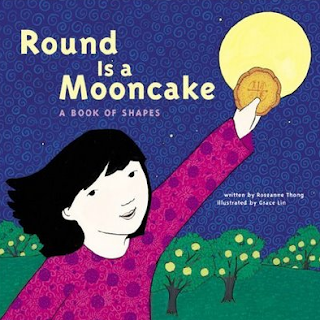
Round is a Mooncake: A Book of Shapes

Roseanne Thong (2000), 34 pages

Illustrated by Grace Lin

Audience: toddlers

Format: picture book

In Thong’s book, Round is a Mooncake, everyday objects, food, and environment construct lessons in shapes and Chinese-American culture. A premise, which creates an interesting and rich backdrop of circle, square, and rectangle shapes as described by one little girl discovering them among her surroundings. The author’s use of simple language, repetition, and rhyming text is engaging and descriptive. For instance, “round is a mooncake, round is the moon; round are the lanterns outside my room.” Thong uses equal parts Chinese and American references to discuss common shapes. For example “square is the box that pizza comes in; and dim sum made by Mrs. Chin” an illustration shows the family eating a meal of pizza slices and Chinese dim sum. In addition, prompting techniques are used throughout the narrative asking the reader to participate: “what other round things to do see?” or “I can name more square things, can you?” – a great way to involve children in the storytelling process. Concept books (literature featuring fundamental shapes, numbers, or letters) are essential to a child’s development. This book is unique serving as a foundation for gaining shape awareness whilst learning Chinese customs and traditions. Pairs nicely with Thong’s picture book, Red is a Dragon: A Book of Colors for a comprehensive look at colors and textures.

Reviewed by: Katharine Quinn, SJSU MLIS Student

If you liked this book, you may like: The Shape of Me and Other Stuff by Dr. Seuss, When a Line Bends … A Shape Begins by Rhonda Gowler Greene, or Brown Rabbit’s Shape Book by Alan Baker

Other books by this author: Red is a Dragon: A Book of Colors, Wish: Wishing Traditions Around the World, Gai See: What You See in Chinatown, and Fly Free!

Tuesday, April 12, 2011

Moo, Baa, La La La!
Sandra Boynton (1982), 8 pages


Audience: babies, toddlers


Format: board book


“Moo, Baa, La, la, la” – sounds like a cow, a sheep, and three singing pigs? Hold on a minute, somehow that doesn’t seem right … I thought pigs said: “Oink?”


Boynton’s unique brand of humor is infectious and pure joy for both children and adults! Her cartoon illustrations are extensions of her witty storylines – this artwork provides personality and character to her books. Hilarious and clever, Boynton has landed a winning combination, entertaining both reader and child. This book will definitely appeal to young children with its rhyming cadence and simple concept (animal sounds). An ideal book for young children who are learning about animals - they can participate by naming the animals and saying the sounds aloud. This best selling book is also available in Spanish titled Muu, Beee, ¡Asi Fue!
Try pairing this book with a boisterous round of "Old MacDonald Had a Farm" during storytime.


Old MacDonald had a farm, E-I-E-I-O
And on his farm he had a cow, E-I-E-I-O
With a "moo-moo" here and a "moo-moo" there
Here a "moo" there a "moo"
Everywhere a "moo-moo"
Old MacDonald had a farm, E-I-E-I-O

Old MacDonald had a farm, E-I-E-I-O
And on his farm he had a pig, E-I-E-I-O
With a (snort) here and a (snort) there
Here a (snort) there a (snort)
Everywhere a (snort-snort)
With a "moo-moo" here and a "moo-moo" there
Here a "moo" there a "moo"
Everywhere a "moo-moo"
Old MacDonald had a farm, E-I-E-I-O

Old MacDonald had a farm, E-I-E-I-O
And on his farm he had a horse, E-I-E-I-O
With a "neigh, neigh" here and a "neigh, neigh" there
Here a "neigh" there a "neigh"
Everywhere a "neigh-neigh"
With a (snort) here and a (snort) there
Here a (snort) there a (snort)
Everywhere a (snort-snort)
With a "moo-moo" here and a "moo-moo" there
Here a "moo" there a "moo"
Everywhere a "moo-moo"
Old MacDonald had a farm, E-I-E-I-O

Reviewed by: Katharine Quinn, SJSU MLIS Student

If you liked this book, you may like: The Cow that Went Oink by Bernard Most, The Noisy Book by Margaret Wise Brow, or Bark, George by Jules Feiffer

Other books by this author: A to Z, Belly Button Book, Blue, Hat, Green Hat, Hippos Go Berserk, Doggies, The Going to Bed Book, Opposites, & many more
Whose Toes are Those?

Jabari Asim (2006), 12 pages

Illustrated by LeUyen Pham

Audience: babies, toddlers

Format: board book

“Who do you suppose has such fine toes?” I wonder … who could it be? Without ruining the surprise you’ll know for sure at the book’s end! Poet, playwright, and author Jabari Asim creates a wonderfully joyous book filled with fun-loving rhymes. He explores feet in a whole new way by taking a creative spin on the traditional rhyme “This Little Piggy Went to Market” where children are encouraged to explore and discover their toes – a popular subject for babies. As babies grow they explore the world around them; some of the first few things they discover are hands and feet. Pham’s original illustrations were drawn graphite sketches digitally painted with computer tools, resulting in vibrant and bubbly pictures. Her images are bright and cheerful complimenting Asim’s poetry perfectly. Author and illustrator pair up again in Asim’s Whose Knees are These? For more reading fun combine these storybooks with a rowdy song of “Head, Shoulders, Knees, and Toes.” Babies and toddlers will love this combination!

Reviewed by: Katharine Quinn, SJSU MLIS Student

If you liked this book, you may like: Head, Shoulders, Knees and Toes by Annie Kubler, Where is Baby’s Belly Button? by Karen Katz or Guess How Much I Love You by Sam McBratney

Other books by this author: Boy of Mine, Girl of Mine, and Whose Knees are These?


Panda Bear, Panda Bear, What do You See?

Bill Martin Jr. (2003), 14 pages


Illustrated by Eric Carle


Audience: babies


Format: board book


Two great children’s authors Bill Martin Jr. and Eric Carle have come together to create a very popular series of “what do you see” books. These books are great fun for babies. Filled with repetitious and cumulative text makes this an easy read and especially enjoyed by babies who follow along and anticipate the next lines. This popular series began with Martin’s Brown, Bear, Brown Bear What Do You See? which teaches children about colors and animals. All of these books are unique in the animals they represent however Panda Bear, Panda Bear What Do You See? features all endangered animals. Examples include water buffalo, spider monkey, green sea turtle, macaroni penguin, and the red wolf. Carle’s illustrations are done in his signature collage-style with bold colors and primitive perspective capturing the essence of each animal. At the end of the book, children are treated to a re-cap of all the animals which effectively works to practice all that they’ve learned. This series translates well to a board book format, which is more accessible for babies.


Reviewed by: Katharine Quinn, SJSU MLIS Student

If you liked this book, you may like: My Big Animal Book by Roger Priddy or My Very First Book of Animal Sounds by Eric Carle

Other books by this author:
The Bill Martin Jr. Big Book of Poetry by Bill Martin Jr. and Michael R. Sampson, A Beasty Story, Chicka Chicka Boom Boom, The Maestro Plays, Brown Bear, Brown Bear, What Do You See? and Polar Bear, Polar Bear, What Do You Hear?

Sunday, April 10, 2011

Wombat Wallkabout

Carol Diggory Shields (2009), 32 pages


Illustrated by Sophie Blackall


Audience: pre-K


Format: picture book


Follow six of the cutest wombats on a walkabout. Deep in the Australian outback they start out on their journey as “six woolly wombats, walking one by one, passed a golden wattle blooming in the sun. The last little wombat, whose name was Clive, stopped to smell the flowers … then there were five.” Oops, now the group has gone from six to five! But his disappearance is not just due to distraction, there happens to be a hungry-eyed dingo tagging along. One by one, the group slowly dwindles down to just two, suddenly … the remaining pair Jen and Jack “thought it awfully quiet, so they looked back. No little wombats? That’s not good! They jumped off the track and hid in the wood.” What should they do? As the dingo approaches the hidden duo soon realize where their friends went … Dingo’s got their mates in a big swag bag. They think of brilliant plan to trick the dingo – and what do you know? Their friends survive … now “Six woolly wombats, good as new. Walked along together, two by two.” Shield’s text is rhythmic without being over the top (seamlessly integrating assonance, alliteration, and rhymes) into each verse. Creating a narrative rich with imagery and substance – she also includes a glossary of Australian terminology such as native wildlife (dingo, wombat, kookaburra) and flora (wattle tree, eucalyptus). Blackall’s illustrations are enchanting; she manages to create adorable characters with personality yet plays homage to the Australian landscape beautifully. This book is ideal for teaching counting, numbers, phonological awareness, and increase vocabulary. A great read-aloud book for kids and adults!


Reviewed by: Katharine Quinn, SJSU MLIS Student

If you liked this book, you may like: Diary of a Wombat by Jackie French, Koala Lou by Mem Fox, or Edward the Emu by Sheena Knowles

Other books by this author: The Bugliest Bug, Food Fight!, and Saturday Night at the Dinosaur Stomp

Other books by this illustrator: Ruby's Wish, Pecan Pie Baby, Edwin Speaks Up, and Big Red Lollipop

Thursday, April 7, 2011

Such a Silly Baby!

Steffanie and Richard Lorig (2007), 30 pages

Illustrated by Amanda Shepherd

Audience: toddlers, pre-K

Format: picture book

“But, there was a hitch … my baby got switched” … no matter where they seem to go (whether the zoo, the circus, or a farm) mother and baby always seem to wind up in the same silly situation! Go on this wild adventure as baby gets swapped numerous times with a chimpanzee, a dancing bear, a lazy sow, etc. Yet, baby manages to adjust just fine to his new surroundings. In fact, when mother comes back for him … he’s full of funny surprises (like swinging from vines and tight-rope walking) … proving that life is never dull when you’re a silly baby! Brimming with humor and energy – the author and illustrator personify “silly” on multiple levels (with a silly storyline, pictures, sounds, etc.) managing to make everything in this book outrageously funny! The text’s rhymes and repetition make this a great read a-loud book for parents; children will squeal with delight when they hear this story alongside Shepherd’s brightly colored whimsical illustrations.

Reviewed by: Katharine Quinn, SJSU MLIS Student

If you liked this book, you may like: Hello Baby! by Mem Fox, Silly Sally by Audrey Wood, or Just One Day by Laura Leuck

Other books by this illustrator: Fiona Loves the Night, Who Loves Me? and Rules of the Wild: An Unruly Book of Manners

Sunday, March 27, 2011

Don’t Say that Word

Alan Katz (2007), 40 pages

Audience: pre-K

Format: picture book

Poor Michael had a big day at school but every time he tries to tell his mom what happened … she steps in to say DON’T SAY THAT WORD! Michael’s recollections all start out innocently enough “at recess we all saw a spider an a bird that went chittery-chirp. Doug snorted as he drank his cider, then let out a two-minute ….” But before he can say the best part … his mother intervenes and as the title exclaims, shouts “Don’t say that word!” However, as Michael gets sent on time-out and has his mouth washed out with soap, its finally his turn to shout “Don’t Say that word!” when his mother says “Well, Michael … today was a sea of great dramas. I hope there are calm days ahead. Run along –put on your pajamas, It’s late and you should be in …” This book is brimming with humor – a hilarious read!

Reviewed by: Katharine Quinn, SJSU MLIS Student

If you liked this book, you may like: Elbert’s Bad Word by Audrey and Don Wood or My Mouth is a Volcano by Julia Cook

Other books by this author: Stalling, Take Me Out of the Bathtub and Other Silly Dilly Songs

Thesaurus Rex

Laya Steinberg (2003), 24 pages

Illustrated by Debbie Harter

Audience: pre-K

Format: Board book

Thesaurus Rex is a playful, active bright-blue spotted dinosaur that finds synonyms for everything he does! For instance, when he plays … he frolics, rollicks, frisks, and romps. While eating he munches, crunches, nibbles, gnaws, and when he gets ready to sleep he doesn’t just leap - he bounces, jumps, springs, and flies into bed. Thesaurus Rex effectively combines educational elements with a kid-friendly character and storyline – making it a must-have book for preschoolers. Kids will have a great time building their vocabulary and discovering new words!

Reviewed by: Katharine Quinn, SJSU MLIS Student

If you liked this book, you may like: Hairy, Scary, Ordinary: What is an Adjective? by Brian P. Cleary, The Boy who Loved Words by Roni Schotter, or Slop Goes the Soup: A Noisy Warthog Word Book by Pamela Edwards

Other books by this author: All Around Me I See

I’m All Ears: Sing into Reading

Fran Avni (1999), 46:39 minutes

Audience: All ages

Format: CD

Twenty-three songs feature rhythmic beats and lyrics that teach children early literacy skills. Each song helps children develop reading readiness skills. For example rhyming techniques are used in “Name Game” (rhyme recognition) and “Good for You” (rhyme completion). Alliteration is featured in numerous songs including “Chugga choo choo,” “Lily,” and “One Wet Windy Wednesday.” Phonemic awareness (sound deletion, isolation, and blending) is highlighted in several songs such as “Pineapple,” “Topsy Turvy” and “Fiddle Around with the Middle Sound.” This CD makes learning educational and fun at the same time!

Reviewed by: Katharine Quinn, SJSU MLIS Student

If you liked this CD, you may like: Singing Sounds: Songs for Learning Early Speech Sounds

Other CDs by this artist: Little Ears: 27 Songs for Reading Readiness and Tuning Into Nature-Songs and Activities about the Earth

Rhymes Round the World

Kay Chorao (2009), 40 pages

Audience: All ages

Format: picture book

From celebrated illustrator Chorao comes Rhymes Round the World, a global compilation of traditional rhymes and songs both familiar and obscure. Translations include rhymes from several cultures and countries such as France’s Are you Sleeping?, Italy’s Cincirenella, Korea’s Wind Last Night, Poland’s Lizzie, Iran’s Morning Song, Greece’s The Girl Wants to Dance, and many more. Chorao’s signature cheerful watercolors bring simple poems, songs, and rhymes alive in her detailed full-page designs. For instance, the traditional Australian song “Kookaburra” illustrates playful laughter as an indigenous eucalyptus tree grows heavy with climbing children and an array of native wildlife (koalas, kangaroos, and the kookaburra bird) ….

“Kookaburra sits in an old gum tree,

Merry, merry king of the bush is he.

Laugh Kookaburra! Laugh, Kookaburra!

Gay your life must be.”

Without a doubt this book is as fun to read as it is to look at! Filled with fun, diverse rhymes, and beautiful images this is a book young audiences will enjoy. Parents and educators can read these rhymes as a way to introduce culture and diversity to children.

Reviewed by: Katharine Quinn, SJSU MLIS Student

If you liked this book, you may like: This Same Sky: A Collection of Poems from Around the World by Naomi Shihab Nye

Other books by this author: The Baby’s Good Morning Book, The Baby’s Bedtime Book, Knock at the Door and Other Baby Action Rhymes

Saturday, March 26, 2011

Ten, Nine, Eight

Molly Bang (1983), 24 pages


Audience: babies, toddlers


Format: picture book


Need a calming countdown to nighttime? Well, look no further! Bang's
Caldecott honored book Ten, Nine, Eight is the answer. Follow a loving daughter and father in their cozy nighttime routine as they get ready for a good night’s sleep ... “ten … small toes all washed and warm; nine … soft friends in a quiet room; eight … square windowpanes with falling snow.” Molly Bang has created a classic bedtime book and a family favorite. Add this story to your nightly repertoire as you prepare your little one for bedtime; also available in Spanish.

Reviewed by: Katharine Quinn, SJSU MLIS Student


If you liked this book, you may like: Feast for 10 by Cathryn Falwell, Goodnight Moon by Margaret Wise Brown
, or Counting Kisses by Karen Katz

Other books by this author: When Sophie Gets Angry—Really, Really Angry (Caldecott Honor Book), The Grey Lady and the Strawberry Snatcher (Caldecott Honor Book), and All of me!

Tuesday, March 15, 2011

The Skin You Live In

Michael Tyler (2005), 32 pages

Illustrated by David Lee Csicsko

Audience: pre-K

Format: picture book

The Skin You Live In by Michael Tyler not only talks about skin's different colors & tones it also talks about all the fun things you can do in your skin … such as "the skin that you have fun in; the skin that you run in; the skin that you hop, skip, and jump in the sun in..." Ending with the moral that what's most important is not the skin, but what's within.


Supplement this book with an activity of coloring. Using Coloring Pages, a free online resource that offers printable templates (sorted by subject) print the "children" series and offer an array of skin tone options with Crayola's Multicultural crayons.


Reviewed by: Katharine Quinn, SJSU MLIS Student


If you liked this book, you may like: Shades of People by Shelley Rotner, The Colors of Us by Karen Katz, and What I Like About Me! By Allia Zobel Nolan


Other books by this illustrator: Behind the Lions: A Family Guide to the Art Institute of Chicago


Sunday, March 6, 2011

Peek-a-Who?

Nina Laden (2000), 10 pages

Audience: babies

Format: board book

Looking for a book to entertain your infant? Look no further. With bold graphic illustrations, creative cutouts, and rhythmic rhyme Laden's take on the classic peek-a-boo board book is the perfect read! Entertaining for both baby and adult; the short, quick rhymes are great for reading aloud, especially fun is the last line where the author writes …Peek-a-Who? … Peek-a-You ... appropriately ending with a foil mirror on the final page for the baby to look at! Published as a sturdy board book means it should hold up to the wear and tear of little hands. For additional reading, pair with In My Nest by Sara Gillingham or Owl Babies by Martin Waddell. Or try incorporating some games ... babies love playing the classic game of Peek-a-boo; play a round after reading to start teaching your baby basic motor skills.

Reviewed by: Katharine Quinn, SJSU MLIS Student

If you liked this book, you may like: In My Nest by Sara Gillingham

Other books by this author: Button Noses, Who Loves You Baby? and Ready, Set, Go!

Language Nursery

Baby Einstein (2002), 62 minutes


Audience: babies


Format: DVD


The Baby Einstein Language Nursery video presents babies with short, colorful vignettes in eight different languages: Japanese, Russian, English, Hebrew, German, Italian, French, and Spanish. The video features traditional rhymes, songs, numbers, alphabets, and lullabies by native speakers and uses very simple imagery (close-ups shots of dolls and toys along with minimal graphics), engages babies’ sense of sight and sound. The DVD contains additional footage of flashcards (29 different vocabulary words) and a video tutorial, which instructs the parents on how to watch the video while interacting with their baby. The Baby Einstein brand declares that the videos should be used in conjunction with parent interaction, citing “that parent-child interaction is one of the most critical elements to the development of a healthy and happy baby during the first three years of life” (Baby Einstein Company, 2007, ¶ 2). Additional videos concentrate on other subjects, such as music (Baby Mozart and Baby Bach), poetry (Baby Shakespeare), and colors (Baby Van Gogh). An excellent source for parents and babies will find the content appealing and fun!


Reviewed by: Katharine Quinn, SJSU MLIS Student


If you liked this DVD, you may like: Little Pim (Series) produced by The Little Pim Co.

Other products by Baby Einstein: Discovering Shapes, Baby Mozart, and Neighborhood Animals

Saturday, March 5, 2011

There’s a Wocket in My Pocket!

Dr. Seuss (1974), 36 pages

Audience: toddlers, Pre-K

Format: picture book

Dr. Seuss is famous for his ridiculous and tongue-twisting rhymes and this book is no exception! There's a Wocket in My Pocket features an entire narration of clever and entertaining nonsense words! These words are an excellent tool for teaching phonemic awareness … have children practice making up words and sounds by replacing the first or last letter of a word (a technique is know as phonemic isolation and substitution) For instance, wocket=pocket, wasket=basket, woset=closet, nink=sink, or yottle=bottle. The possibilities are endless! A great read-aloud book, parents and children will have fun making up words and listening to the rhymes.

Reviewed by: Katharine Quinn, SJSU MLIS Student

If you liked this book, you may like: Jamberry by Bruce Degen

Other books by this author: Hop on Pop, Foxs in Socks, Yertle the Turtle and Other Stories

What Rhymes with Eel? A word-picture flap book

Harriet Ziefert (1996), 16 pages

Illustrated by Rick Brown

Audience: babies, toddlers

Format: picture book

Children and parents will love this interactive picture book! By removing one letter in the word and replacing it –new words are formed. For instance, remove the “C” in Carrot and replace with “P” … what do you get? Parrot; a perfect tool to teach phonemic-isolation and segmentation plus the rhymes are easy to sound out, allowing children to hear the blending between the sounds.

Use this book in addition to ReadWriteThinks' Construct-A-Word game to boost phonemic awareness; for instance, participants can try finding all the "ig" or "an" words. Parents and educators can practice this technique on their own (just remember to speak slowly and elongate sounds) by asking kids what certain sounds words make, such as b/at (bat), l/ate (late), or s/and (sand), a great way to learn onset rhymes!

Reviewed by: Katharine Quinn, SJSU MLIS Student

If you liked this book, you may like: Dear Zoo: A Lift the Flap Book by Rod Campbell

Other books by this author: Who said Moo? Lift the Flap Book and Where is My Friend? A Hide and Peek Book

Monday, February 28, 2011

All The World

Liz Garton Scanlon (2009), 40 pages

Illustrated by Marla Frazee

Audience: All ages

Format: picture book

A recent 2009 release and Caldecott honoree, Scanlon’s All the World reflects multiculturalism in a subtle, but effective way. Scanlon's repetitive prose “all the world ...has got its sky ... all the world ... goes round this way ... all the world ... is you and me" and Frazee’s watercolors echo the book’s universal message of family with charm and personality. Children will enjoy the detailed illustrations and the juxtaposition of simple portraits against sweeping, panoramic landscapes. A feel-good book that will appeal to children and families of all backgrounds! The traditional folksong "We've Got the Whole World in Our Hands" works well as a precursor or addendum to storytime:

We've got the whole world in our hands.

We've got our mamas and our papas in our hands.
We've got the whole world in our hands.

We've got our brothers and our sisters in our hands.
We've got the whole world in our hands.

We've got the little bitty baby in our hands
We've got the whole world in our hands.

We've got our aunts and our uncles in our hands.
We've got the whole world in our hands.

We've got our grandmas and our grandpas in our hands.
We've got the whole world in our hands.

We've got the earth and the water in our hands.
We've got the mountains and the valleys in our hands.
We've got the oceans and the rivers in our hands.
We've got the whole world in our hands.

We've got the whole world in our hands.

Reviewed by: Katharine Quinn, SJSU MLIS Student

If you liked this book, you may like: Whoever You Are by Mem Fox

Other books by this author: A Sock is a Pocket for Your Toes and Noodle & Lou